Flat Rate vs Hourly Pricing for House Cleaning: Which Pays You More?
Quick answer
Hourly pricing punishes a fast crew. Flat pricing rewards it, as long as your time estimate is right. Most recurring house cleaning works best as a flat price built from estimated hours. Hourly (or hourly with a not-to-exceed limit) fits jobs you cannot estimate well, like heavy first cleans or cluttered move-outs.
"Should I charge by the hour or a flat rate?" is one of the most common questions new cleaning owners ask. The honest answer: you should think in hours either way, because hours are your biggest cost. The question is only what the client sees.
The same job, priced both ways
Let's take one example home: 3 bedrooms, 2 bathrooms, 1,800 sq ft, one pet. Our time model estimates 4.09 cleaner-hours on site. The costs are the same as in our pricing guide: an $18 wage plus a 15% labor burden, paid drive time, vehicle, supplies and overhead.
- Flat price: cost ÷ (1 − 30% margin) = $199.80, whatever the time.
- Hourly price: an example rate of $45 per cleaner-hour on site. Drive time is not billed.
Now look at what happens when the job goes faster or slower than planned:
| Time on site | Hourly bill | Flat price | Your cost | Profit, hourly | Profit, flat |
|---|---|---|---|---|---|
| 3.27 h (20% faster) | $147.24 | $199.80 | $122.93 | $24.31 | $76.87 |
| 4.09 h (as planned) | $184.05 | $199.80 | $139.86 | $44.19 | $59.94 |
| 4.91 h (20% slower) | $220.86 | $199.80 | $156.80 | $64.06 | $43.00 |
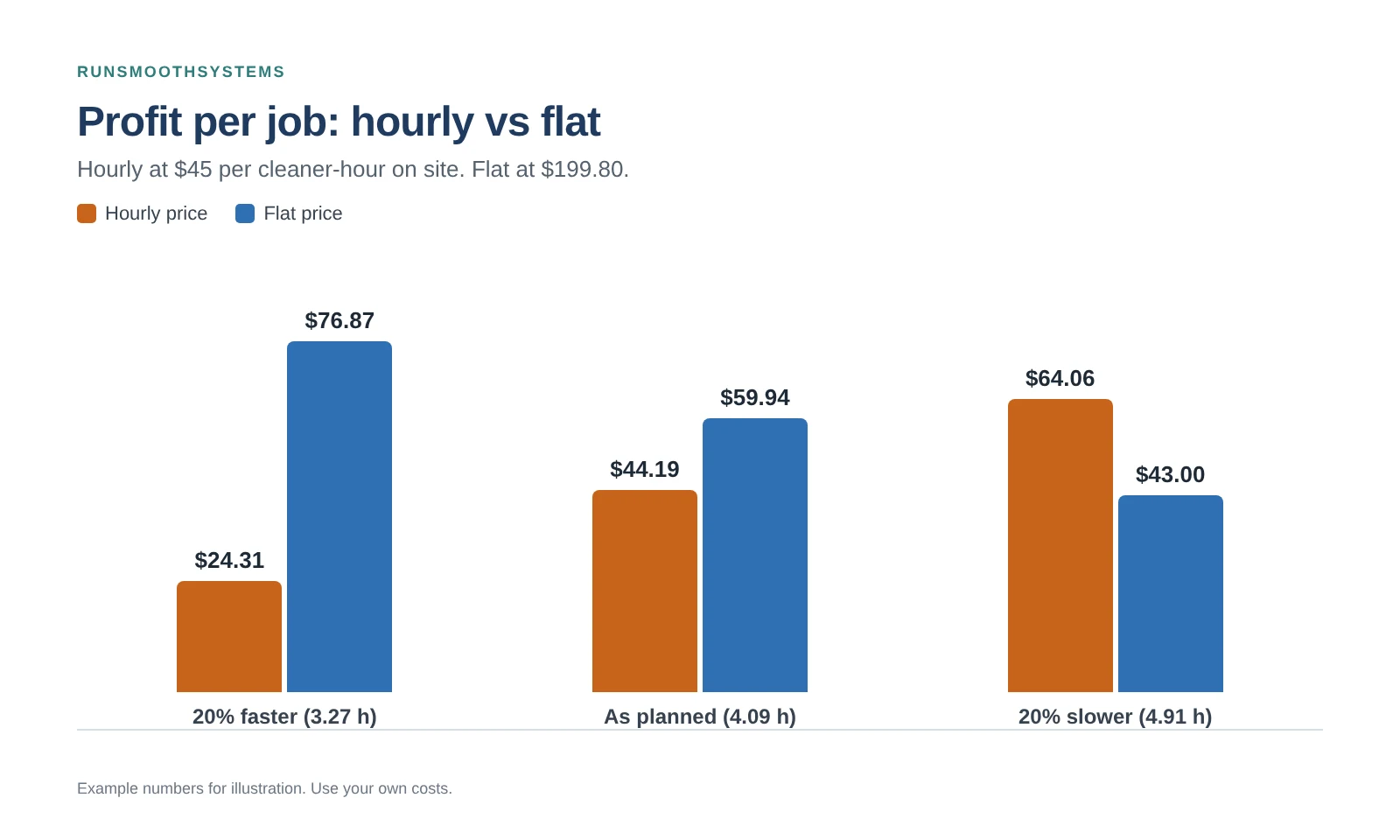
Two things to notice:
- With hourly pricing, a faster crew earns you less. Your best, most experienced cleaners make the least profit per job.
- With flat pricing, the risk is your estimate. If you under-estimate the time, you absorb it.
In this example the hourly rate also does not cover drive time, so its profit is lower at the planned time. You could raise the hourly rate to cover it. That makes the comparison closer, but the incentive stays the same.
What clients usually prefer
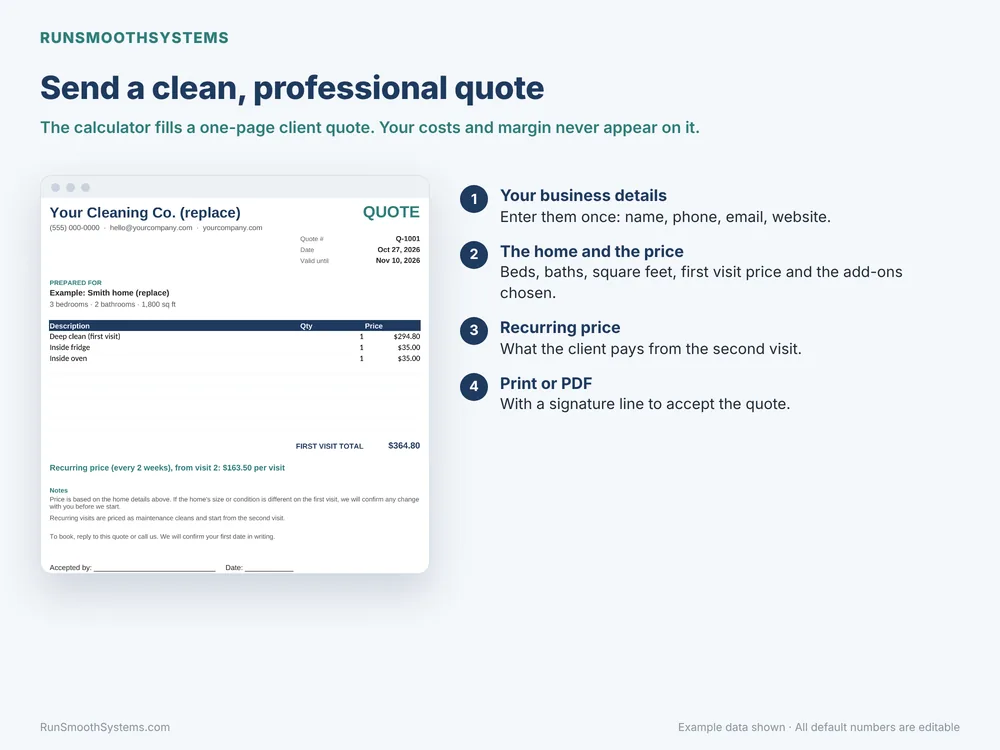
Many homeowners prefer a flat price because they know the total before you start. They do not have to wonder if the crew is working slowly. A clear flat price, with a short list of what is included and what costs extra, also makes your quote look more professional.
Some clients ask for hourly because they think it is cheaper. You can offer them a time limit instead. More on that below.
When flat rate works best
- Recurring visits (weekly, every two weeks, monthly), once the home is at maintenance level
- Standard cleans where you know the home from the first visit
- Teams with a stable routine and a checklist
Build the flat price from hours anyway. If you do not know your hours, you are guessing your profit.
When hourly (or a hybrid) works better
- Heavy first cleans where you cannot see the real condition until you start
- Move-outs with clutter, or homes that were not described accurately
- Organizing or one-off tasks with no clear end
Two hybrid options protect both sides:
- Hourly with a not-to-exceed limit: "Billed at $X per cleaner-hour, up to a maximum of $Y. If we need more time, we ask first."
- Flat with a condition clause: "This price assumes the home is in the condition described. If it is very different, we confirm a new price before we start."
Five rules that make flat pricing safe
- Time your first three standard cleans and correct your estimate.
- Price the first visit separately from recurring visits.
- Use a minimum job price so small jobs still cover travel.
- List add-ons with prices (inside oven, inside fridge, interior windows), so extras are never free.
- Check actual hours against estimates every few weeks. If one client always runs long, re-quote.
Paying cleaners when you charge flat
You can still pay your team by the hour, as most employers do. Your flat price already includes their hours. Some owners pay 1099 subcontractors a flat amount per job instead. In that case, use the flat pay as your labor cost when you build the price.
Frequently asked questions
Is hourly pricing illegal or bad practice?
No. It is common, especially for one-off and heavy jobs. The main risk is that it rewards slow work and makes your price hard for the client to predict.
How do I switch existing clients from hourly to flat?
Look at their last few visits, take the average time, build a flat price from it, and offer it from a set date. Many clients welcome a fixed price.
What hourly rate should I charge?
Build it from your costs like any other price. Your loaded labor cost, drive time, supplies, overhead and margin all have to fit inside it.
Can I charge flat for deep cleans?
Yes, if you can estimate the time. Use a deep clean time factor, add a condition clause, and price it separately from maintenance visits. See our [deep clean pricing guide](/blog/how-much-to-charge-for-deep-cleaning/).
Example numbers in this guide are for illustration. Use your own costs. This is not legal, tax or accounting advice.
Sources
- Example numbers are illustrations built with the method in this guide, not industry data.